

Ecogate Sales Agent Program
Know a factory with a dust collector?
If you can introduce us, we’ll handle everything — and share the project revenue with you.
Ecogate upgrades existing industrial dust collection systems to reduce energy use and improve airflow performance in manufacturing facilities.


You don’t need to understand dust collection.
If you’ve been inside a facility where you’ve seen:
• Large ductwork running through the ceiling
• A big fan or baghouse outside the building
• Wood, metal, or material dust being extracted from machines
You likely know a qualified facility.
We pay 10% of the project value for successful introductions
Typical project: ~$150,000
You make ~$15,000 when the project closes
Get in touch
How to qualify lead based on financial motivation
-
75+ HP dust collector
-
Multiple shifts will make a project exponentially more viable
-
Weekend Operation a bonus
-
Is the main duct velocity 4000FPM+ when collector is running at full speed (60hz)?
How to qualify lead based on other motivations
-
Does your system have inadequate suction / velocity at specific or all workstations?
-
Is the noise from the dust collector making the work environment much louder?
-
Does management want to be able to datalog the efficiency / productivity of specific workstations or employees at individual workstations?
-
Is the system currently over capacity > are you considering upsizing your dust collection system?


Industrial Ventilation Upgraded With Ecogate
1
2
3
4
5
Click me
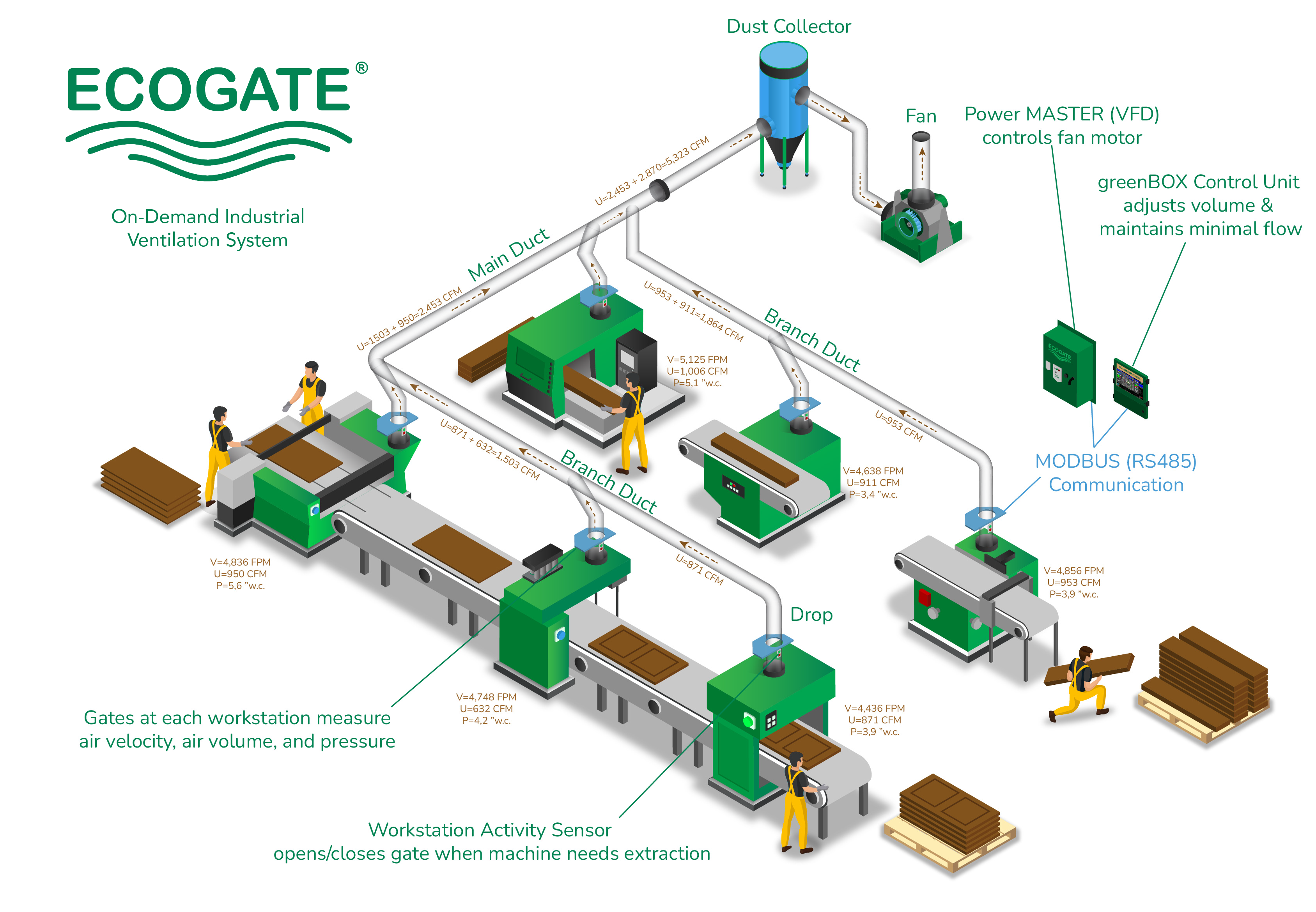
Sensors detect when a machine is about to generate dust or fumes.
Triggered by the sensor, the Smart Gate opens for active machines, directing airflow only where needed.
The greenBOX calculates the exact airflow needed and opens or closes gates in real time.
Power Master VFD adjusts fan speed based on real-time demand, reducing energy.
Any dust collector error automatically stops the fan.
How Ecogate Improves Ventilation Systems
Conventional Systems vs Intelligent Ventilation
The Smartest Investment in Dust Collection
Ventilation systems equipped with Ecogate may have a higher initial investment, but over time they cost significantly less to operate. By reducing energy use by up to 70%, lowering mechanical wear, and extending filter life, they deliver a 35–40% reduction in total cost of ownership.
Conventional systems run at full power all day, wasting energy and accelerating wear regardless of actual demand. Ecogate adds intelligence, delivering the right amount of airflow only when and where it’s needed. The result is a return on investment within 1-3 years making the Ecogate system pay for itself and then some.
How Substantial Savings are Possible
Leveraging the Fan Law
Fan power doesn’t decrease at the same rate as airflow—it follows the Affinity Laws, meaning small reductions in air volume lead to exponentially larger energy savings. For example, cutting airflow by just 30% reduces fan power demand by nearly 70%, as shown in the graph. This is because fan energy consumption is proportional to the cube of airflow reduction.
10% reduction in airflow → ~27% energy savings
25% reduction in airflow → ~68% energy savings
50% reduction in airflow → ~87.5% energy savings
How Common are the Savings?
Average Workstation Utilization
Managers often assume machines operate continuously, estimating utilization at 80% or more based on busy production floors. But data from hundreds of Ecogate installations, mostly U.S. woodworking facilities, reveals actual utilization averages around just 50%.
Machines don’t need ventilation during loading/unloading, setup, programming, cleaning, maintenance, or idle periods. Recognizing this difference between a machine being on and a machine needing ventilation uncovers substantial energy savings potential.