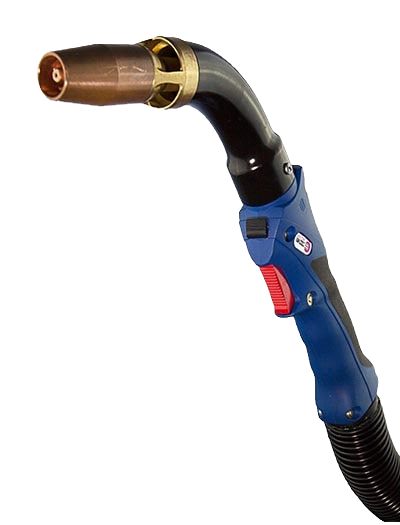
Detect welding demand
A dry contact, voltage signal, current sensor, local control, or industrial timer tells the assigned gate that the workstation requires extraction.
Explore activity sensors
Central welding fume extraction systems often run every booth at full airflow even when only a few welders are active. Ecogate detects welding activity, opens extraction at the appropriate workstation, and adjusts collector fan speed to current demand.
This creates a responsive welding ventilation system designed to reduce wasted fan electricity and conditioned make-up air while maintaining configured airflow at active extraction points.
Welders stop to position parts, change consumables, inspect work, move between setups, and prepare the next weld. Training facilities also have demonstrations, instruction periods, and staggered activity. A conventional central system may continue moving the airflow required for every connected station through those intervals.
When actual workstation utilization and expected peak concurrent use are considered, the same dust collector may be able to serve more installed welding guns while maintaining the required airflow at each active gun. This can help avoid or defer the capital cost of a larger collector and related equipment.
Illustrative only. Workstation utilization should be measured or documented for the actual process, shift, and production schedule.
Ecogate coordinates the extraction response from the first activity signal through the end of the configured collection period.
A dry contact, voltage signal, current sensor, local control, or industrial timer tells the assigned gate that the workstation requires extraction.
Explore activity sensors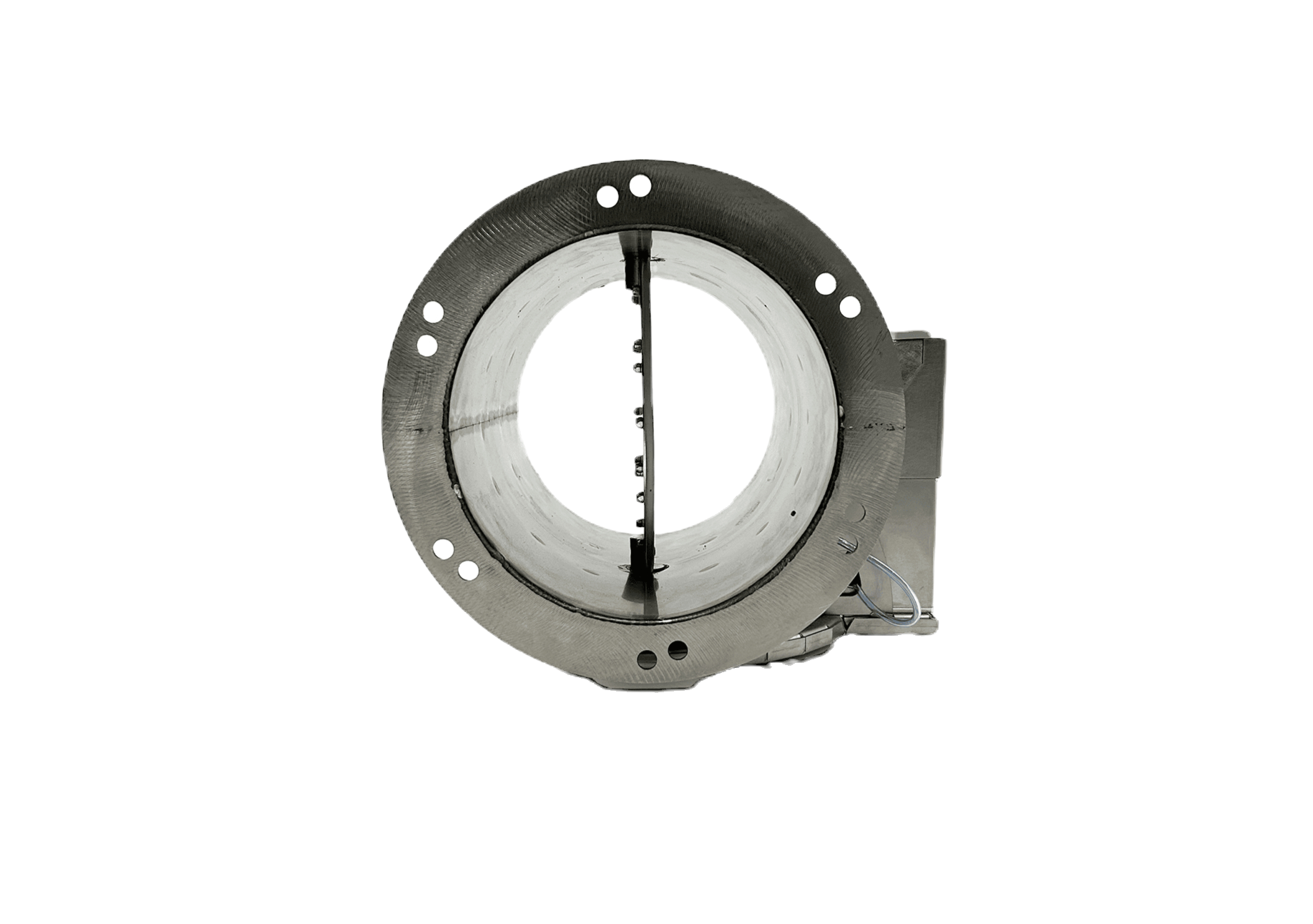
The assigned automatic Butterfly Gate opens. Gate bodies are available down to 2 inches for small-diameter connections.
Explore automatic gates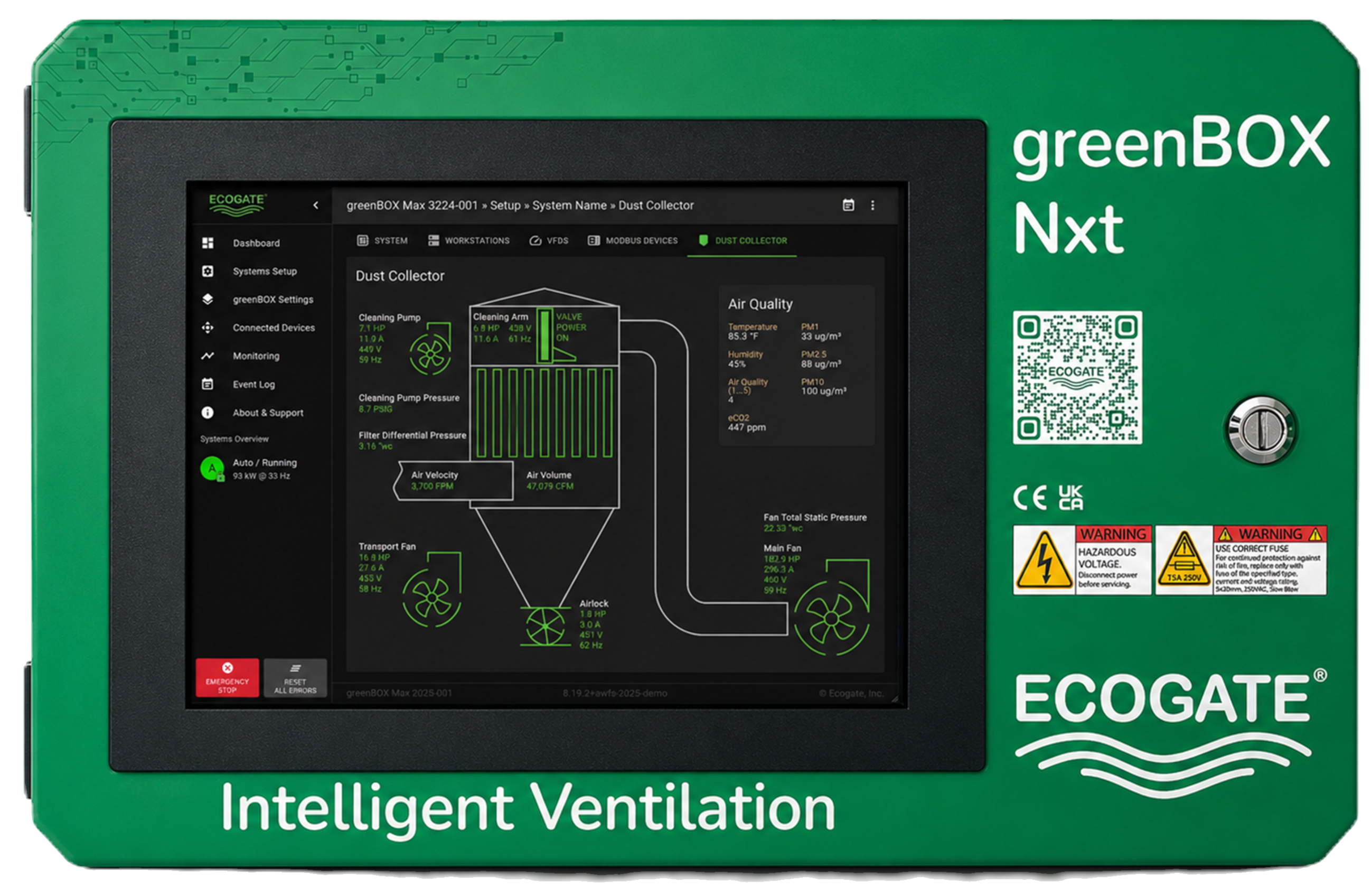
The greenBOX coordinates active extraction points and calculates the airflow required by the current combination of welding stations.
Explore the greenBOX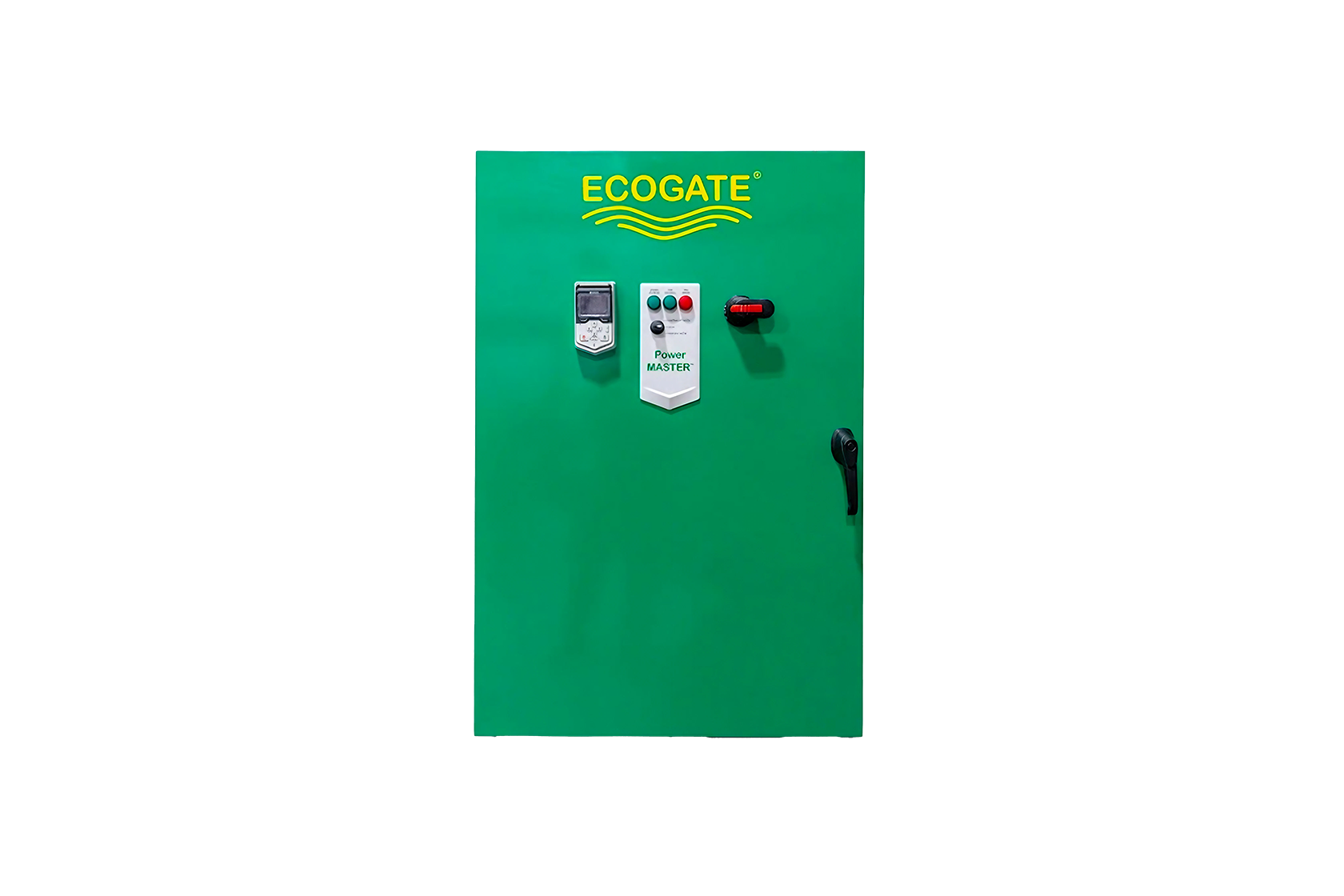
A Power Master VFD changes collector fan speed as the combination of active welding stations changes.
Explore Power Master VFD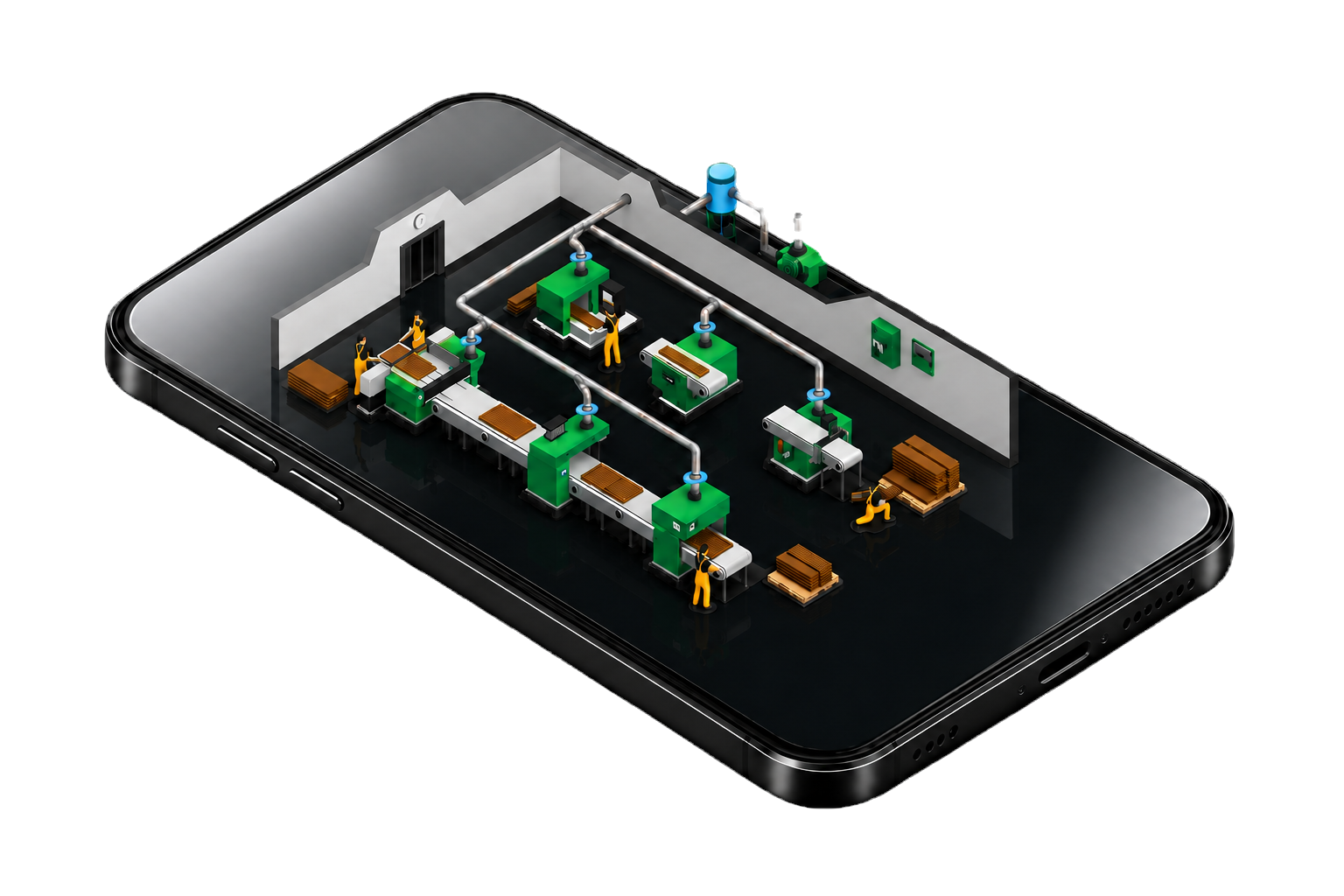
System data makes workstation demand, airflow, pressure, fan power, utilization, events, and operating trends visible.
Explore Ecogate Analytics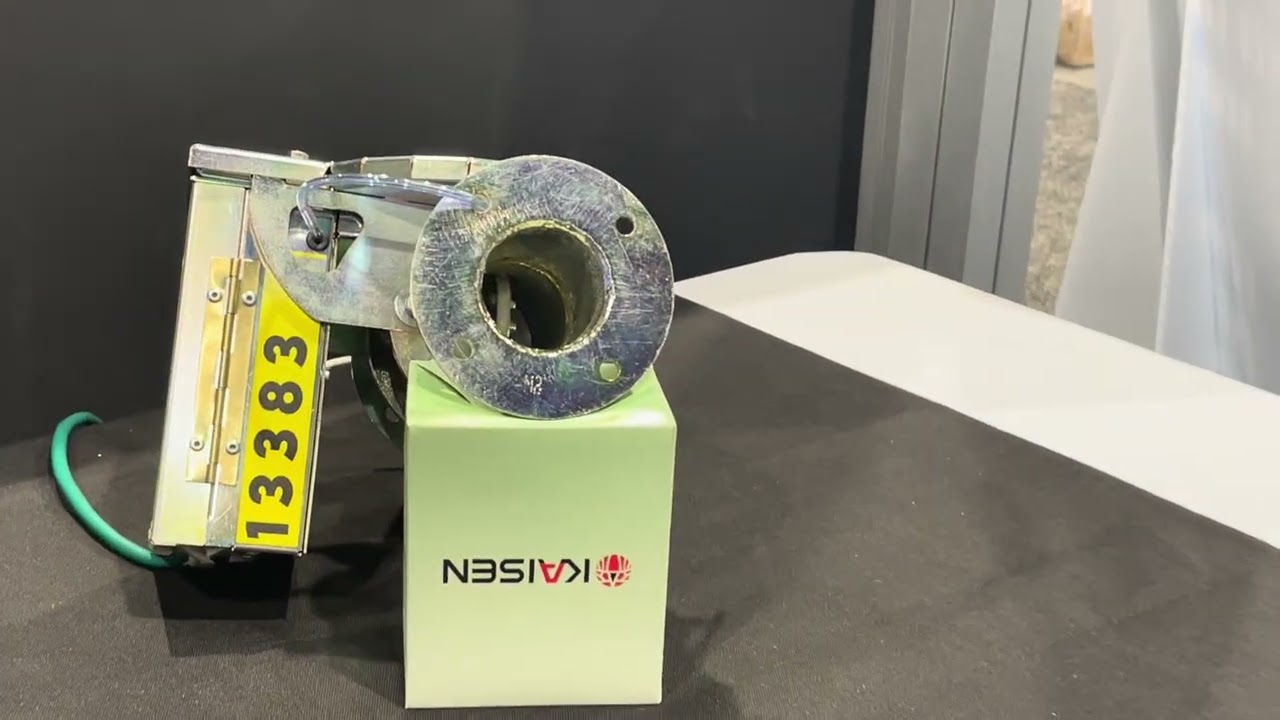
The correct local exhaust ventilation capture device and airflow requirement depend on the process. Ecogate coordinates demand after those engineering requirements have been established.
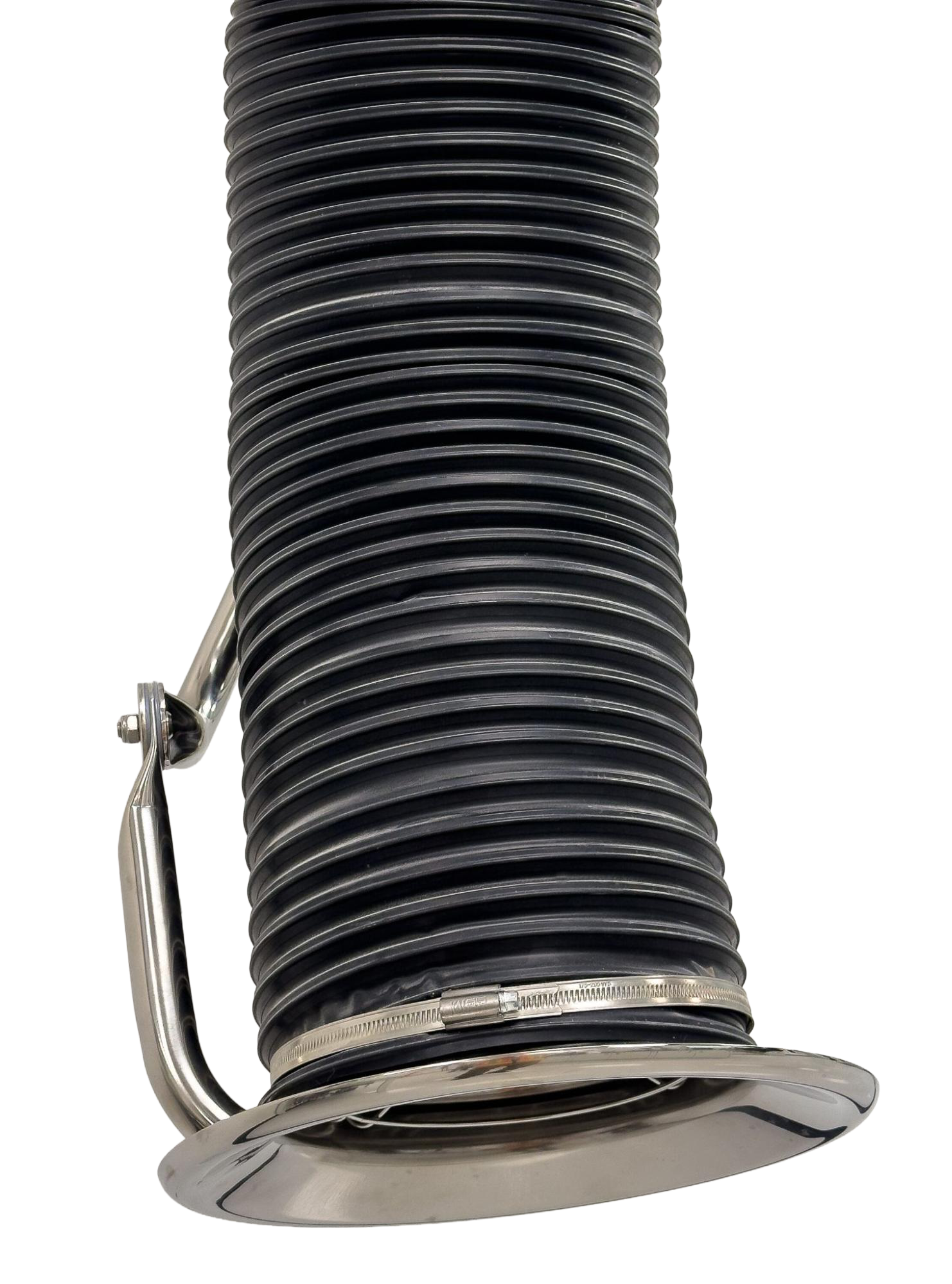
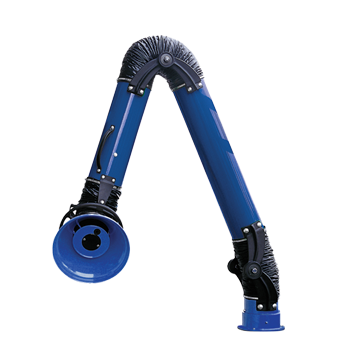
Small-diameter connections collect fumes close to the welding arc. A Butterfly Smart Gate can automate the connection to a shared high-vacuum or central extraction system.
Operator-positioned arms can be activated by a local switch, timer, equipment signal, or other suitable input. The assigned gate opens when extraction is requested and closes when the configured operating period ends.
On-demand control is especially useful when many booths share one collector but only a portion are active at the same time.
Equipment controls or dry contacts can provide a predictable extraction request as automated production cells cycle.
Ecogate can coordinate other fume and light-particulate extraction points when the gate body, capture method, airflow, material loading, and collector are appropriate for the process.
A running fan does not, by itself, confirm what is happening at each extraction point.
Ecogate Smart Gate Actuators measure pressure, air velocity, and air volume at the gate and send that information to the greenBOX over Modbus. An Averaging Air Velocity Sensor can provide additional clean-side measurement where included in the engineered system.
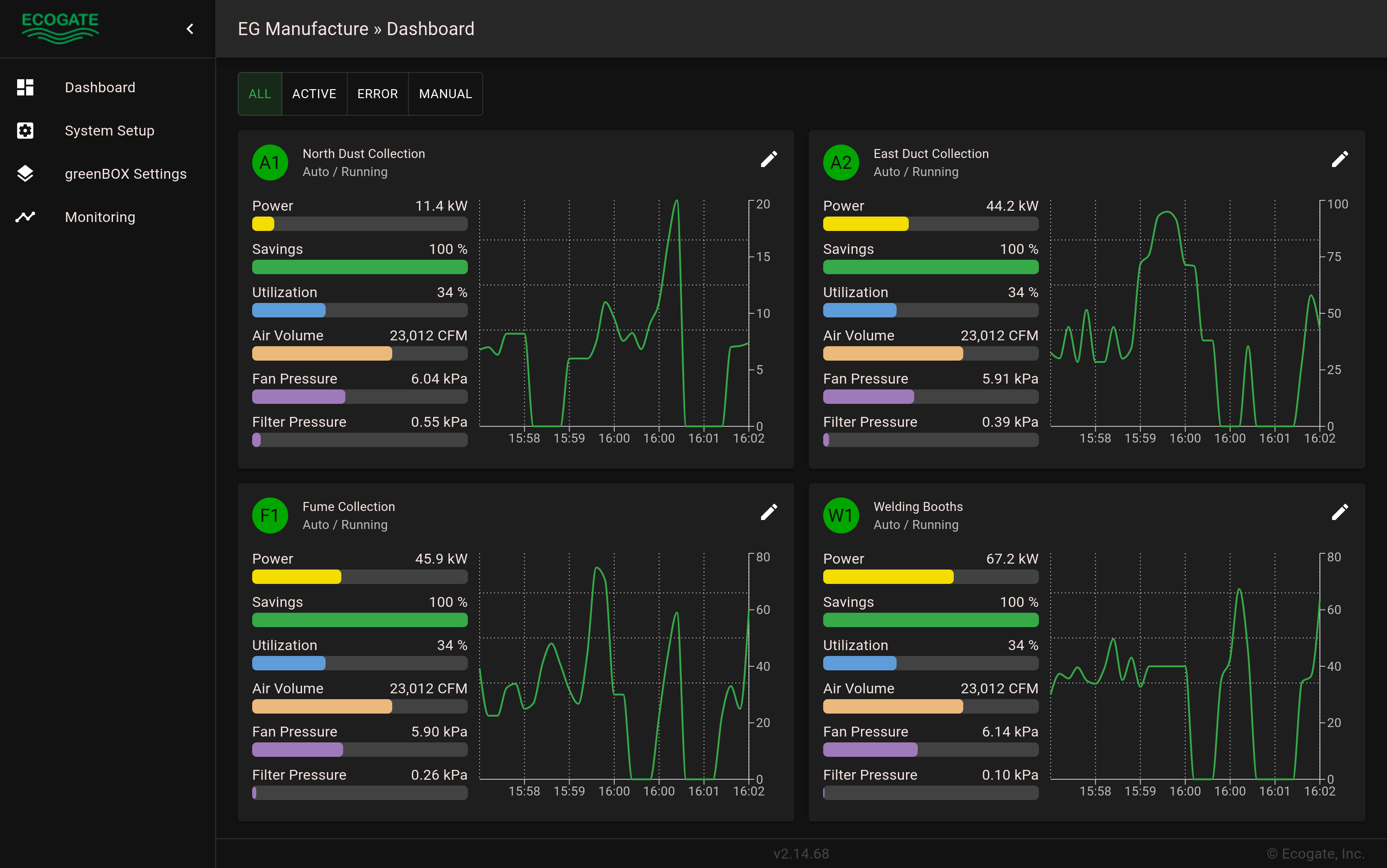 Systems overview in Ecogate software
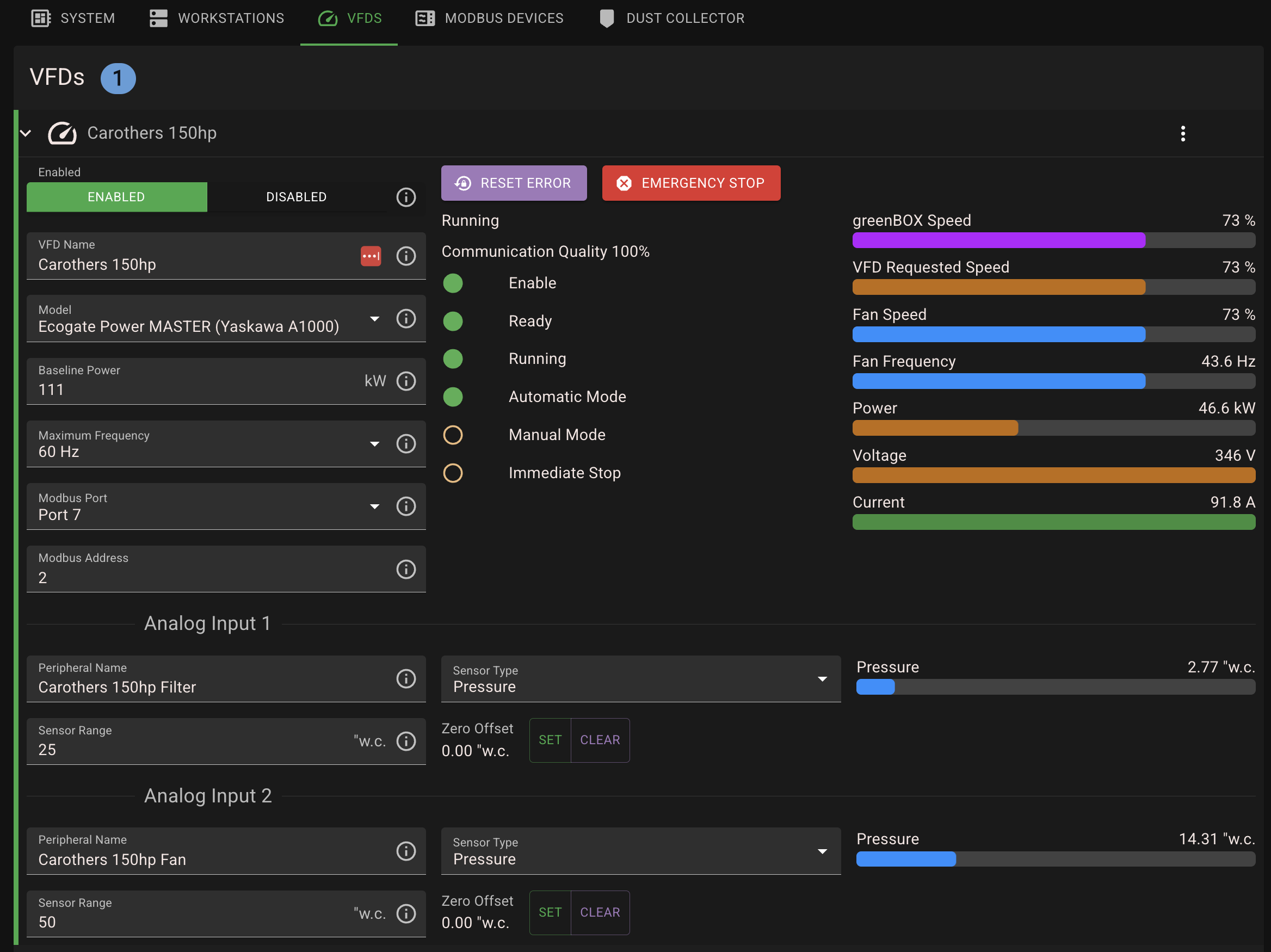 Variable Frequency Drive settings in Ecogate software
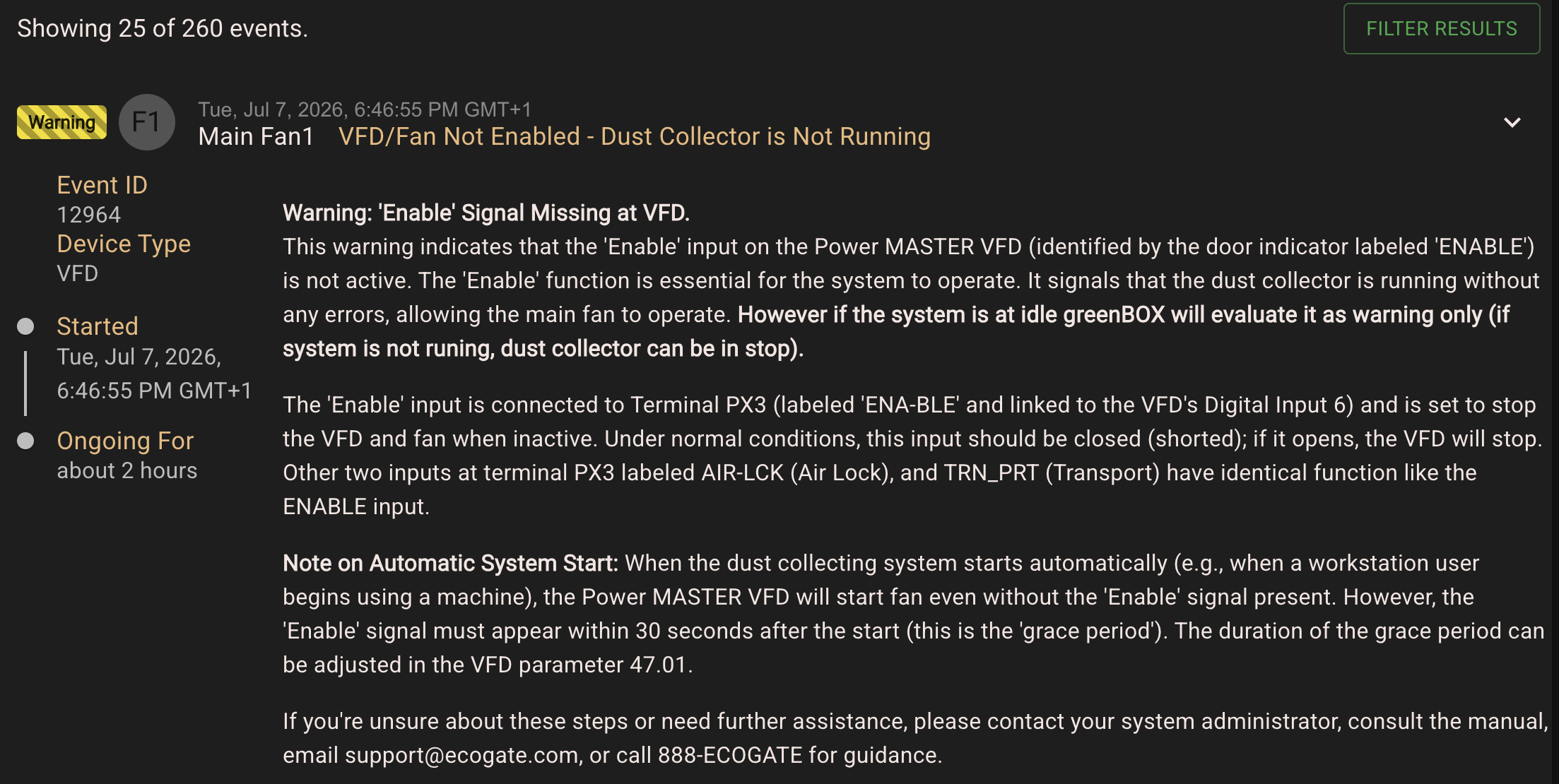 Get warnings and events with 'how to resolve' instructions
Ecogate measures and controls ventilation-system conditions. It does not measure airborne contaminant concentration in a worker's breathing zone or replace industrial hygiene assessment, exposure sampling, capture-device design, filtration, respiratory protection, or other required controls.
The financial opportunity comes from matching welding fume extraction airflow to actual production demand.
Actual results depend on workstation utilization, fan horsepower, operating hours, system condition, and other project-specific factors.
A calculator result is preliminary. A project-specific analysis should use measured baseline fan power, design and working airflow, operating hours, electricity rate, workstation utilization, conditioned make-up air, and the actual fan and duct system.
When fewer stations require extraction, the Power Master VFD can reduce fan speed. Fan power changes roughly with the cube of fan speed.
Reducing unnecessary exhaust may also reduce the energy required to heat or cool incoming replacement air.
Many utilities offer custom incentives for qualified industrial efficiency projects. Availability, calculation, approval, and funding vary, and incentives are not guaranteed.
Lower fan speed can reduce ventilation-system noise during lower-demand periods. Actual sound reduction depends on the installed system and operating condition.
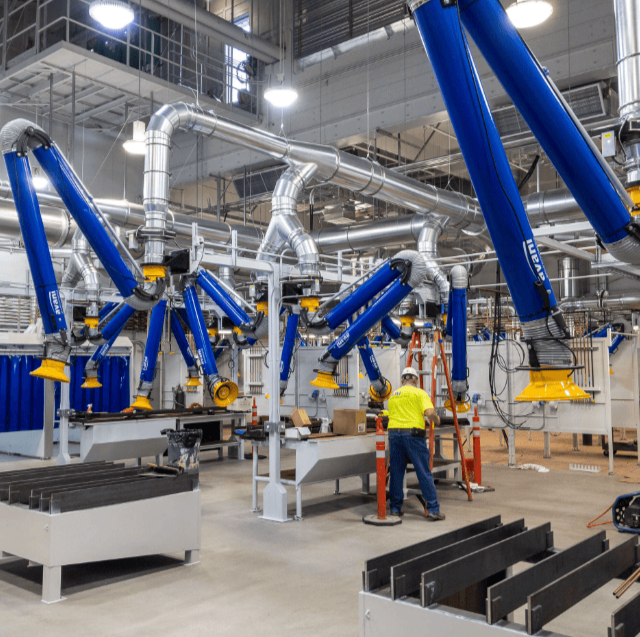 Rock Creek Campus welding shop
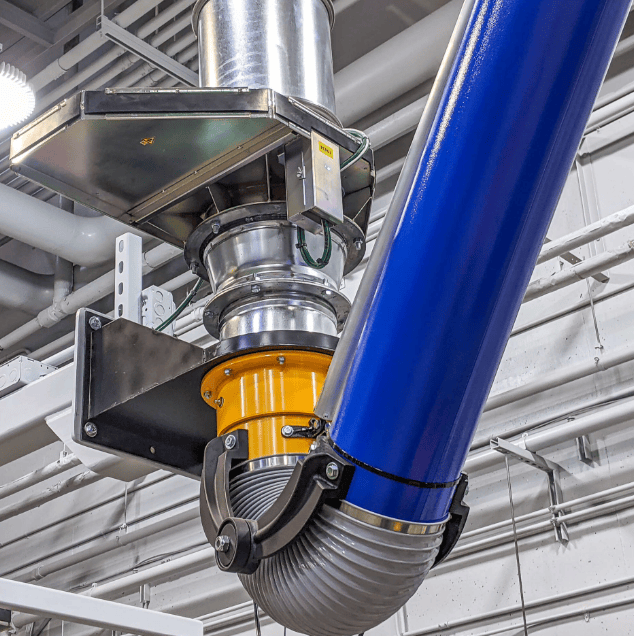 On-demand welding ventilation
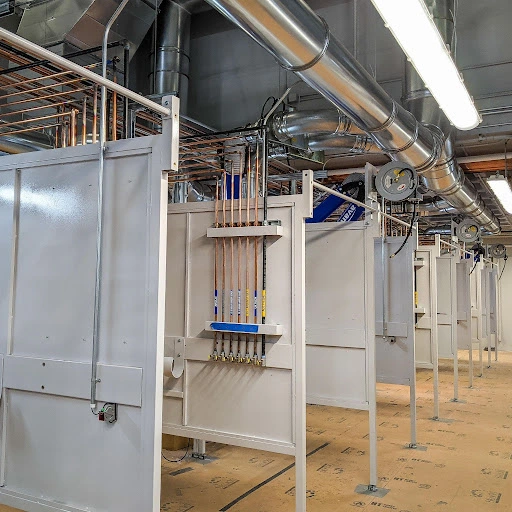 Project system equipment
Portland Community College specified an energy-efficient exhaust system for its Rock Creek Campus welding school that could respond whether one booth or all 75 booths were operating.
The project uses Ecogate Optimized Cascading Fans mode and closed-loop fan control. Fan capacity comes online in stages as more booths request extraction. The Honeywell Tridium building automation system also reads Ecogate data, including measured ventilation air volume, to coordinate the make-up air system.
Those figures are specific to the Portland Community College system and operating scenarios described in the published case study. The project also reports make-up air savings, automatic system start and stop, and reduced shop noise.
Read the Portland Community College Case StudyIn many cases, yes. Ecogate can be evaluated as an upgrade to an existing central dust, mist, or fume collection system, or included in a newly designed system.
The first step is an engineering review. If the collector, fan, ductwork, and capture devices are performing appropriately, demand-based control may be added without replacing the entire extraction system. Existing airflow, pressure, duct, collector, or capture problems should be identified and addressed as part of the project.
Ecogate is the demand-based airflow-control layer. It coordinates activity sensors, automatic gates, the greenBOX controller, fan-speed control, and system-performance data. Capture devices, ductwork, collectors, filters, fans, and other safety controls remain part of the complete engineered system.
The activity signal can come from a dry contact, suitable voltage signal, current sensor, local switch, industrial timer, or another engineered input. The correct method depends on the welding equipment and how the workstation is operated.
Yes. Smart Gate systems provide a configurable Off Delay that can keep the assigned gate open after the activity signal ends. The delay is established during configuration or commissioning for the workstation's operating needs.
Yes. Ecogate Butterfly Gate bodies are available from 2 through 26 inches. The 2-inch body is suitable for small-diameter fume extraction connections when correctly selected and engineered for the application.
Smart and Precision Airflow Gate Actuators measure pressure, air velocity, and air volume at the gate. Standard Gate Actuators provide automatic open and close operation with limit-switch confirmation but do not provide gate-level airflow measurement.
No single control component proves facility-wide compliance. Ecogate can document configured ventilation airflow and system performance, but worker exposure also depends on the process, materials, coatings, capture design, equipment positioning, filtration, work practices, personal protective equipment, and exposure assessment.
Often, yes. Ecogate reviews the collector, fan, motor, ductwork, capture devices, airflow, pressure, controls, and operating pattern to determine what can remain and what needs to change.
Savings are estimated from project-specific inputs including measured baseline fan power, required and working airflow, operating hours, electricity rate, workstation utilization, fan performance, and conditioned make-up air.
Share your workstation count, extraction methods, collector and fan information, operating schedule, and current challenges. Ecogate can help determine whether demand-based airflow control fits your existing system, expansion, training facility, or new ventilation project.