The Industrial Dust Collector Market Is Growing Fast — Here's What Manufacturers Need to Know
A new HTF Market Insights report pegs the global market at $5.8 billion in 2025, on track for $12.9 billion by 2034. Regulations, energy costs, and smart technology are converging — and the facilities that read these trends correctly will hold a meaningful competitive advantage.

If you operate a facility that generates dust — whether you're in metalworking, pharmaceutical manufacturing, food processing, chemicals, or cement production — the market research is sending an unmistakable signal: industrial dust collection infrastructure is no longer optional, and investment in it is accelerating globally.
According to the Global Industrial Dust Collectors Market Size, Growth & Revenue 2024–2034 report published by HTF Market Insights in February 2026, the global industrial dust collectors market is valued at $5.8 billion in 2025 and projected to reach $12.9 billion by 2034 — a robust 7.8% CAGR with 7.5% year-over-year growth. North America holds the dominant market position. Asia-Pacific is the fastest-growing region.
That's more than a doubling of market value in under a decade. Understanding what's driving that growth — and how it maps to your facility's own decision-making — is the focus of this post.
Seven Forces Driving Industrial Dust Collector Market Growth
The HTF report identifies a clear cluster of growth drivers that, taken together, explain why this market is expanding at nearly 8% annually. None of these are passing trends — they're structural forces reshaping how facilities budget for dust control infrastructure.
1. Tightening Environmental Regulations
The primary engine of demand is regulatory pressure. Governments across North America, Europe, and Asia have materially tightened industrial air quality standards — and enforcement is accelerating. In the United States, two developments are especially consequential:
NFPA 660 (effective December 2024) — the new unified combustible dust standard that consolidates six previously separate codes into one. Every facility processing a combustible solid must now conduct a Dust Hazard Analysis (DHA) and remediate any identified gaps. Penalties include operational shutdowns and daily fines that regularly exceed the cost of a modern dust collection upgrade.
EPA Silica Dust Regulations — requiring facilities to maintain respirable crystalline silica concentrations below 50 µg/m³. Many older continuous-run systems cannot meet this threshold without significant upgrades.
The HTF report also highlights revised National Ambient Air Quality Standards (NAAQS) in North America between 2019 and 2024, the EU's updated Industrial Emissions Directive emphasizing Best Available Techniques for dust control, and China's Ministry of Ecology and Environment enforcement of mandatory advanced dust filtration in key manufacturing sectors. New dust explosion prevention standards globally have also required collectors to incorporate explosion venting and suppression systems — directly affecting product design across the industry.
2. Occupational Health and Safety Awareness
Beyond compliance, there's a generational shift in how industrial operators think about worker health. Growing awareness of the long-term consequences of dust exposure — respiratory disease, occupational asthma, carcinogen exposure — is driving facilities to prioritize dust control independently of regulatory mandates. The HTF report identifies this as a distinct growth driver: reducing workplace hazards and improving employee productivity, not just avoiding fines.
3. Smart Technology: IoT, Automation, and Real-Time Monitoring
The HTF report is explicit: investments in smart dust collection technologies integrating IoT and automation are enabling real-time monitoring and predictive maintenance, enhancing system performance and lowering operational costs. This is attracting a new class of industrial buyer — operations managers and plant engineers who think about dust collection in terms of data, uptime metrics, and total cost of ownership.
This shift is also visible in what the market's largest players are building. In 2024 alone, the HTF report documents four significant smart-technology moves by major dust collection competitors:
The pattern is consistent: the largest players in the global dust collector market are aggressively investing in intelligence, connectivity, and energy efficiency — which is exactly where buyer expectations are heading.
4. Rapid Industrialization in Asia-Pacific
Asia-Pacific is the fastest-growing region in the HTF report, driven by rapid infrastructure development and industrial expansion in China and India. As new manufacturing floor space comes online and environmental enforcement tightens, demand for compliant dust collection accelerates. North America, meanwhile, holds the dominant market position — anchored by strict regulatory frameworks and a highly diversified industrial base.
5. Demand for Customized Solutions
The HTF report identifies increasing demand for dust collection solutions tailored to specific industrial applications as a meaningful growth driver. Pharmaceutical manufacturing, food processing, and specialty chemicals require systems optimized for their unique process environments — contamination control, cleanroom compatibility, explosion risk management — rather than generic configurations. This is pushing the market toward more sophisticated, application-specific installations.
6. Government Incentives for Sustainable Manufacturing
Government incentive programs promoting sustainable industrial practices are encouraging facilities to upgrade existing dust collection infrastructure ahead of compliance deadlines. In the United States, many utilities offer substantial rebates for industrial energy efficiency projects — in documented cases covering 50–70% of total project cost. For facilities with aging constant-run systems, this creates a financially compelling case for proactive upgrades that might otherwise be deferred.
7. Advanced Filtration Technology
Manufacturers are increasingly incorporating advanced materials — including nanofibers and PTFE membranes — that improve dust capture efficiency, extend filter life, and reduce replacement frequency. As these materials become more cost-effective, they're raising the performance baseline for the entire market and creating upgrade opportunities at facilities where older filtration media is no longer adequate for current regulatory standards.
Market Segmentation: Which Industries and Products Are Leading
By Application
The HTF report segments the market across five primary application verticals: Metalworking, Pharmaceuticals, Food Processing, Chemicals, and Cement. Metalworking and pharmaceuticals are the leading applications, driven by stringent workplace safety and contamination control requirements. The report notes that cartridge collectors — the fastest-growing product type — are gaining disproportionate traction in pharmaceutical and food processing environments due to their compact design and ease of installation in space-constrained facilities.
By Product Type
The report covers five collector technologies: Baghouse Collectors, Cartridge Collectors, Cyclone Collectors, Electrostatic Precipitators, and Wet Scrubbers. Baghouse collectors dominate as the leading product type — favored for high filtration efficiency, cost-effectiveness at scale, and suitability across a broad range of industrial environments. Cartridge collectors are the fastest-growing segment, driven by their compact footprint and versatility in environments with space or access constraints.
By End-Use Industry
The report's end-use segmentation covers Automotive, Manufacturing, Construction, and Mining. Manufacturing captures the largest share of revenue within this grouping. Construction is an increasingly significant contributor as infrastructure development accelerates globally and air quality regulations extend to construction sites.
The Challenges Holding Facilities Back — and How to Address Them
The HTF report is candid about the barriers to adoption. Understanding these is important for any facility evaluating a dust collection upgrade, because the way each challenge is framed often determines whether an investment gets approved or deferred.
"High initial capital expenditure for advanced dust collection systems can deter small and medium-sized enterprises from investing, limiting market growth potential in certain regions and industries."
This is the most cited barrier — and also the most addressable. Facilities citing capital cost as a barrier are typically comparing the upfront system cost against a zero baseline, rather than against the ongoing operating expense of the system already running. When the comparison is properly framed as current system total cost of ownership versus upgraded system total cost of ownership, the math almost always favors upgrading — often dramatically, especially when energy savings compound over a 5–10 year horizon.
Other challenges the HTF report identifies:
Maintenance complexity — large-scale systems can increase downtime and total cost of ownership if not properly managed. Smart monitoring and predictive maintenance capabilities directly address this.
Varying regulatory frameworks — compliance requirements differ across geographies, complicating procurement for multi-site manufacturers operating in multiple regions.
Integration challenges — retrofitting dust collection systems into existing industrial infrastructure without disrupting production is a real constraint that affects deployment timelines and installation planning.
Limited technical awareness — many industrial operators don't fully understand what a modern on-demand system actually delivers versus what they're currently running, particularly regarding energy savings potential.
Each of these is a solvable problem — but only when the right technology partner is involved early in the evaluation process.
What the Market Looks Like Through 2034
The HTF report's core projection — $5.8 billion in 2025 to $12.9 billion by 2034 at a 7.8% CAGR — implies sustained, broad-based demand across all major industrial sectors through the end of the decade and beyond. A few specific dynamics worth watching:
North America's regulatory enforcement cycle will continue to drive retrofit investment as NFPA 660 DHA requirements move from awareness to active enforcement across woodworking, pharmaceutical, and food processing facilities — and as OSHA increases inspection frequency for silica and combustible dust violations.
Smart and IoT-enabled systems will capture a disproportionate share of new installations, as buyers increasingly require real-time monitoring, cloud-based analytics, and remote diagnostics as standard features rather than premium add-ons.
Asia-Pacific expansion will accelerate as China's environmental enforcement drives mandatory adoption of advanced filtration across key manufacturing sectors — compressing timelines that would otherwise play out over decades.
Modular and scalable systems will gain traction among small and medium-sized manufacturers who have historically been priced out of advanced dust collection technology — as the market develops lower-barrier, phased-deployment configurations.
For facilities still operating conventional constant-run dust collection systems, the implication is straightforward: the longer you wait to upgrade, the more you're paying — in electricity, in compliance risk, and in a capital cost environment that will only move upward as inflation continues to affect equipment and installation pricing.
How Ecogate's On-Demand Control Systems Address Every Major Market Driver
Everything the HTF report identifies as a growth driver — energy efficiency, smart monitoring, regulatory compliance, IoT integration, and measurable ROI — is exactly what Ecogate has been engineering for over 25 years.
Ecogate manufactures the greenBOX, an on-demand dust collection control system — a patented, closed-loop intelligent control platform that opens and closes Smart Gates at active workstations, adjusts fan speed in real time via a variable frequency drive, and measures actual airflow at every individual gate simultaneously. The result is an average of 66% electricity savings, with documented results ranging from 50% to 75% depending on facility utilization patterns.
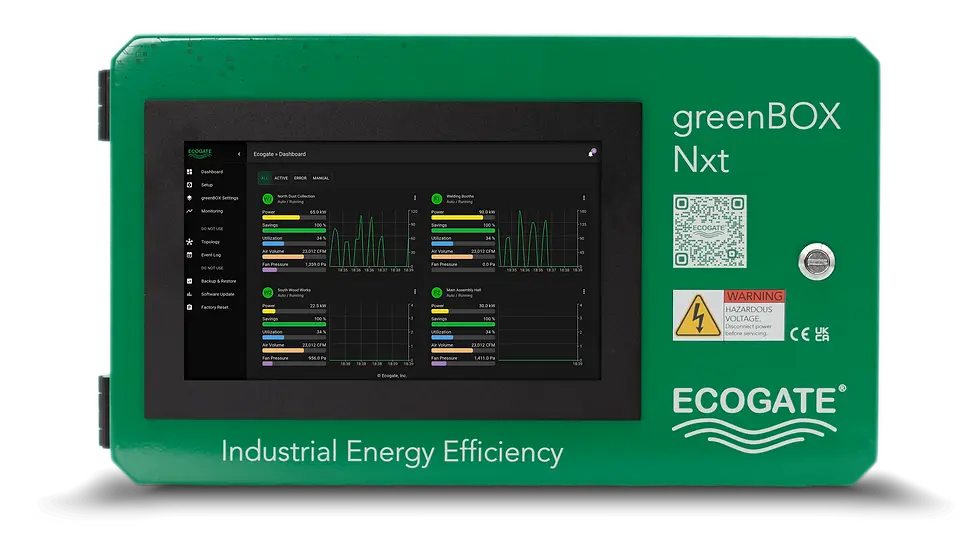
greenBOX Nxt
Handles up to 75 Smart Gates, includes 3 Modbus ports, and a 10.1" touchscreen puts real-time system status front and center — the kind of intelligence the market is moving toward.

greenBOX Max
Scales up to 150 Smart Gates across 6 Modbus ports, with dual redundant power and a 15.6" 4K OLED touchscreen — built for large facilities that need mission-critical reliability alongside the smart monitoring capabilities the market is demanding.
For even larger systems, check out the greenBOX Master.
The HTF report's competitor intelligence provides a useful reference point: Donaldson's February 2024 launch of energy-efficient cartridge dust collectors for pharmaceutical environments claims up to 25% energy reduction through improved filtration media. Ecogate's on-demand control systems, applied across the same categories of facilities, consistently deliver 50–75% electricity savings — by addressing the fundamental problem at the controls level. Most dust collection energy waste isn't a filter problem. It's a controls problem.
The key technical distinction: unlike competitors that rely on pneumatic (compressed air-driven) gates or basic time-delay automation, Ecogate's system measures actual airflow — pressure, velocity, and volume — at every gate simultaneously and feeds that data back into the control algorithm continuously. This is what makes safe fan speed reduction possible without ever compromising transport velocity or risking duct plugging. It's patented because no one else does it this way.
On IoT and smart monitoring: The HTF report identifies IoT integration as one of the defining trends shaping the market's future. Ecogate Analytics — the cloud platform included with greenBOX systems — provides real-time and historical energy data, system performance reporting, and remote diagnostics from any browser. Over-the-air firmware updates mean the system improves over time without requiring a service visit.
On NFPA 660 compliance: Ecogate systems are engineered with NFPA 660 requirements in mind. Co-Founder and Chief Engineer Ales Litomisky provides stamped engineering drawings and participates directly in calls with building inspectors and fire marshals when facilities need compliance documentation. For any facility navigating a Dust Hazard Analysis under the new unified standard, that technical authority matters.
The economics are well-documented. On a 75 HP fan motor running 4,500 hours per year, a typical Ecogate installation projects approximately $33,000–$37,000 in combined electricity and HVAC savings annually. On a 200 HP system, those savings can exceed $70,000 per year. Two Ecogate customers currently save over $1,000,000 annually. ROI typically lands in 1–3 years, often under 2.
And when utility rebate programs are available — which they are across a growing number of US states — the effective payback compresses further. In one documented case, Puget Sound Energy covered 70% of the total project cost for a customer.
Ecogate systems are now available through Donaldson Company's global dealer network — the same Donaldson listed as the leading company in the HTF Market Insights report — making it easier than ever to specify, procure, and install an on-demand dust collection control system through your existing equipment relationships.
The window for getting ahead of regulatory enforcement and energy cost escalation is narrowing. Use our free Electricity Savings Calculator to see what your facility would save — or reach out directly to talk through your system with our engineering team.
See What On-Demand Dust Collection Would Save Your Facility
Talk to an Ecogate engineer. We'll review your system, estimate your savings, and answer any NFPA 660 compliance questions — no pressure, no commitment.


Comments