How Ecogate’s Power Master VFD Evolved for On-Demand Dust Collection
Industrial dust collection systems can waste a lot of electricity when the fan runs at full speed all day, even when only a few workstations are active.
That is the core problem Ecogate was built to solve.
An Ecogate On-Demand Control System automatically opens gates only where work is happening, determines how much airflow the system needs, and adjusts the dust collector fan to match real-time demand. The Power Master VFD is the part of the system that makes that fan speed control possible.
But the Power Master is not just a generic variable frequency drive in a cabinet. Over more than two decades, Ecogate has continued refining it for the real-world needs of on-demand dust, fume, and mist collection: reliability, safe manual operation, easier setup, better diagnostics, better communication with the greenBOX controller, and better system visibility.
This is how the Power Master VFD evolved.
Why the VFD Matters in On-Demand Dust Collection
A VFD lets the dust collector fan slow down when the system does not demand full airflow. That matters because fan power follows the Fan Affinity Laws: fan power changes roughly with the cube of fan speed.
For example, reducing air volume by 20% can reduce fan power by about 49%.
That is why VFD control is central to Ecogate’s energy savings. However, slowing a fan is only safe and useful when the entire dust collection system is being controlled intelligently. If a fan is slowed without controlling gates and minimum transport velocity, dust can settle in the ductwork.
Ecogate solves this by combining the greenBOX controller, Workstation Activity Sensors, Smart Gates, airflow measurement, and the Power Master VFD into one control system. The VFD adjusts fan speed, but the greenBOX decides what the system actually needs.
2000: The First Power MASTER VFD
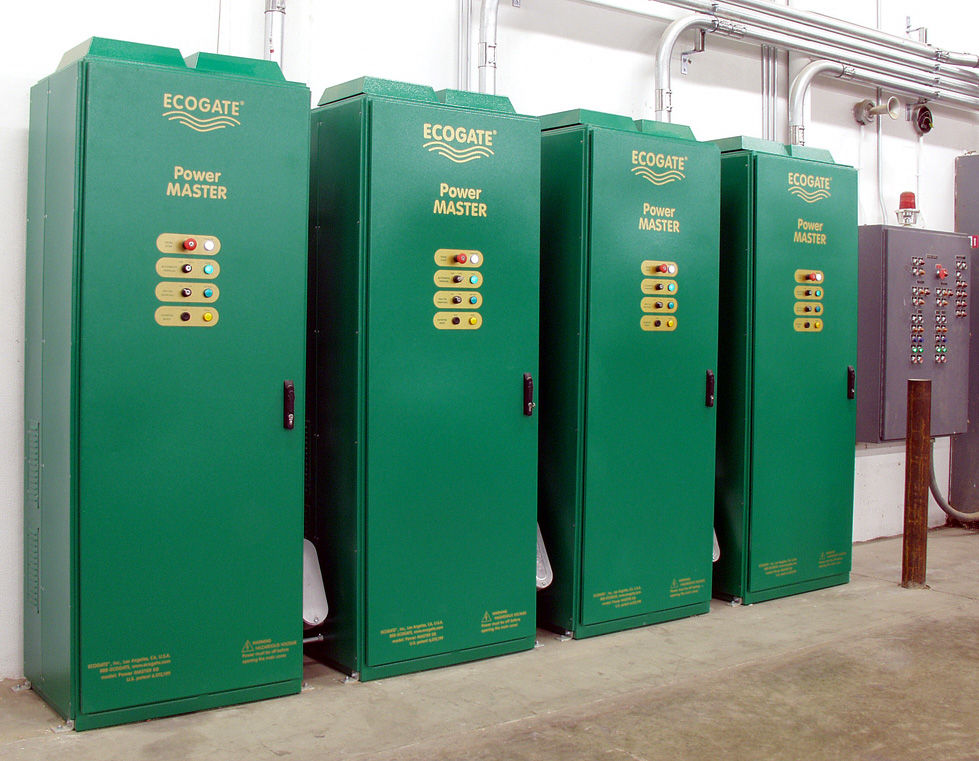
First introduced in 2000, the Ecogate Power Master VFD was based on the Omron 3G3PV drive, manufactured by Yaskawa for Omron, and was available for fan motors up to 450 HP.
Ecogate introduced its first Power Master VFD around 2000, using the Omron SYSDRIVE 3G3PV platform, produced by Yaskawa for Omron.
At the time, VFD technology was still less mature than it is today. Reliability was the main design concern. Ecogate used a three-contactor bypass arrangement so the fan could continue running even if the VFD was unavailable.
Ecogate also developed a custom relay-based logic board, called the RelayCard for Power MASTER, to connect the VFD with the PLC-based greenBOX MASTER through Modbus RTU.

First-generation Ecogate Power Master VFD internals, based on the Omron 3G3PV drive manufactured by Yaskawa for Omron.
This first generation was compatible only with PLC-based greenBOX MASTER systems. For customers still running this equipment, the practical question today is usually not repair versus repair. It is whether the system should be modernized to current greenBOX and Power Master technology.

The Omron 3G3PV-based Power Master used Ecogate’s custom “RelayCard for Power Master,” a relay-based logic board that served as the control interface for the PLC-based greenBOX Master
2007: Yaskawa P7 “Naked” VFDs
When Ecogate introduced the first Windows-based greenBOX MASTER systems, the system architecture became more scalable. These systems introduced Smart Actuators with Modbus daisy-chain communication, which made larger systems easier to wire and control.
From about 2007 to 2010, some Ecogate installations used “naked” Yaskawa P7 VFDs.
A “naked” VFD is the drive itself without a dedicated dust-proof enclosure, disconnect, or fuses. Those components had to be handled separately in the electrical panel.

As part of the first Windows-based greenBOX MASTER installations, Ecogate used Yaskawa P7 “naked” VFDs between 2007 and 2010
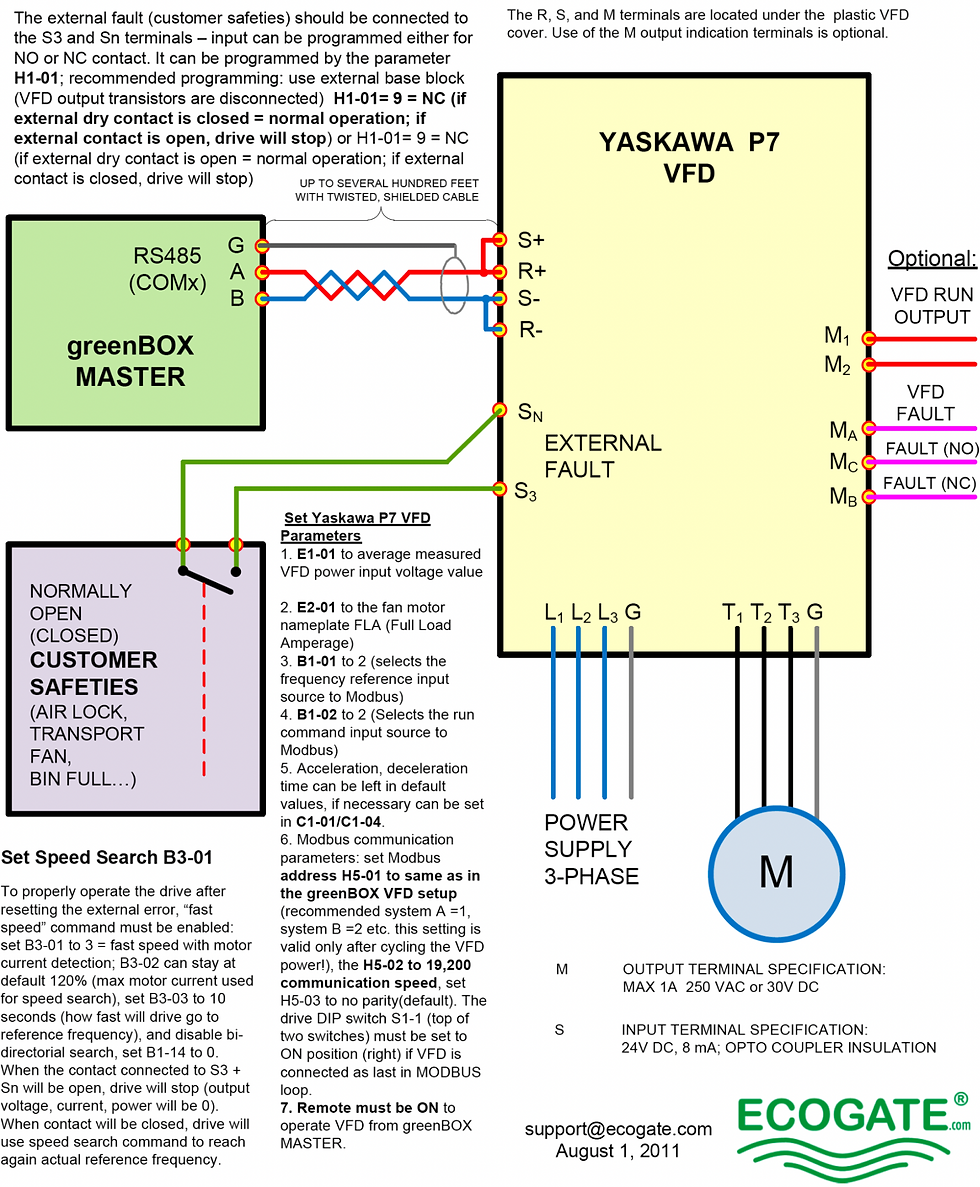
Wiring diagram for “naked” Yaskawa P7 VFDs used with Windows-based greenBOX MASTER systems.
These drives can be compatible with legacy Windows-based greenBOX MASTER systems and current Adelie-based greenBOX systems, but they represent an earlier stage in Ecogate’s VFD integration. The VFD could be controlled, but the installation was less purpose-built than later Power Master generations.
2010: The Yaskawa P7 Bypass Generation
Around 2010, Ecogate began using the Yaskawa P7 Bypass VFD with Windows-based greenBOX MASTER systems.
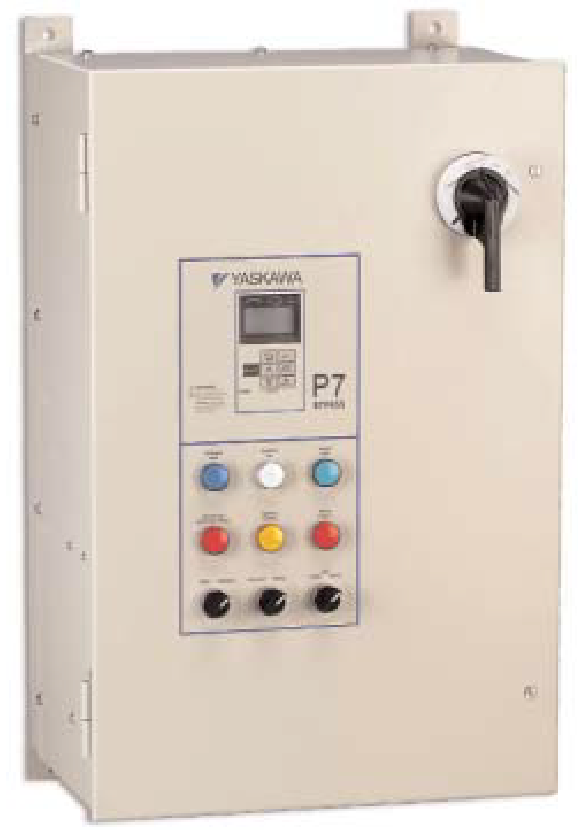

Beginning in 2010, Ecogate used Yaskawa P7 Bypass VFDs with Windows-based greenBOX MASTER control systems. The P7 Bypass was an off-the-shelf HVAC drive package designed to operate ventilation fans
The P7 Bypass was an off-the-shelf HVAC-oriented product. It included a Yaskawa P7 VFD, a three-contactor bypass, a control panel, selector switches, indicators, and a relay-based logic board.
The bypass approach made sense in the early years of VFD adoption, when keeping the fan available during drive issues was a major concern. But relay boards and contactors also add complexity. Over time, those mechanical and relay-based components can become service points.
This generation is compatible with legacy Windows-based greenBOX MASTER systems and Adelie-based greenBOX systems, but Ecogate generally recommends evaluating an upgrade to current Power Master VFD technology.
2012: Yaskawa A1000 and the Move Toward Integrated Fan Control
The Yaskawa A1000-based Power MASTER was a major turning point.
Developed in collaboration with Yaskawa USA and Yaskawa UK, this generation made the Power MASTER more than a VFD cabinet. It became a more complete Ecogate fan-control platform.
Key improvements included a front-door Manual-Stop-Auto selector, easy-to-understand status indicators, embedded “Small PLC” logic using Yaskawa DriveWorksEZ, manual mode operation independent of the greenBOX controller, activity-based dust collector start and stop, fan and filter pressure transmitters integrated into the Power MASTER enclosure, Modbus communication of pressure values back to the greenBOX, backup 24V DC processor power through the Ecogate MASTER cable, dust-proof enclosure design with disconnects, fuses, and external heatsink cooling, and factory-preconfigured Ecogate parameters.


In cooperation with Yaskawa USA and Yaskawa UK, Ecogate developed the Yaskawa A1000-based Power Master VFD, introducing several important fan-control and integration improvements
This generation also reflected a practical field lesson. Earlier systems relied heavily on bypass contactors and relay logic. Ecogate’s experience showed that those components could become failure points. The A1000 generation removed the bypass contactor and relied on the reliability of the VFD itself.
That made the system simpler, cleaner, and more aligned with how Ecogate wanted on-demand fan control to work.
2016: ABB ACS880 and the Ecogate Setup Assistant
In 2016, Ecogate moved the Power MASTER platform to the ABB ACS880 industrial VFD.

The ABB ACS880-based Power Master VFD includes an easy-to-navigate graphical interface. Ecogate’s Setup Assistant streamlines VFD configuration into a short guided process, helping electricians achieve reliable setup and proper greenBOX compatibility.
This ABB-based generation retained the important Ecogate-specific features from the A1000 generation: Manual-Stop-Auto control, embedded drive logic, status outputs, backup processor power, Modbus communication, dust-proof enclosure design, and simplified greenBOX connection.
The biggest advancement was the Ecogate Setup Assistant.

Ecogate’s Setup Assistant simplifies installation by guiding users through Power MASTER VFD configuration in just minutes, reducing setup errors and saving time during commissioning.
A standard VFD can require hundreds of parameters to be configured correctly. That takes time, and manual setup errors can be difficult to troubleshoot. The Ecogate Setup Assistant turns configuration into a guided process, helping installers set up the Power Master quickly and consistently for Ecogate greenBOX operation.

Ecogate Power MASTER VFD with ABB ACS880 drive, shown as a standalone unit for 250 HP to 400 HP fan motors.
For customers, the value is straightforward: easier setup, no configuration mistakes, clearer operating modes, better diagnostics, and tighter integration with the greenBOX controller.

Ecogate Power MASTER VFD with ABB ACS880 drive, shown in a wall-mounted enclosure for fan motors up to 200 HP at 460V AC
2026: Pressure Monitoring Moves to the Dust Collector Interface
The newest update changes where certain system measurements happen.
In 2026, Ecogate introduced a Power Master configuration that removes the fan and filter pressure transmitters from inside the Power Master cabinet. Those measurements now move to the Dust Collector Interface, which is installed closer to the dust collector and connected to the greenBOX through the Ecogate MASTER cable.
The Dust Collector Interface can include sensors for averaging air velocity / air volume measurement, filter differential pressure, fan static pressure, vacuum or compressed air pressure for filter cleaning, and ambient temperature, humidity, and atmospheric pressure.
This change makes sense because the Dust Collector Interface is physically closer to the collector. Shorter hose runs can reduce installation complexity and cost while giving the greenBOX the system data it needs.
This is also consistent with Ecogate’s broader direction: move more monitoring intelligence to the right place in the system, simplify installation, and give operators better visibility into dust collector performance.

List of VFDs compatible with Adelie greenBOX units as May 2026
What the Evolution Shows
The Power Master VFD has changed because on-demand dust collection has changed.
The earliest systems focused on keeping the fan running if the VFD failed. Later generations focused on cleaner integration, better communication, simpler wiring, pressure monitoring, easier setup, and improved diagnostics. The current ABB ACS880-based Power Master continues that direction with a purpose-built Ecogate setup experience and integration with the greenBOX platform.
The lesson is simple: a VFD is only one component. The real value comes from controlling the fan as part of a complete On-Demand Control System.
Ecogate combines sensors, automatic gates, greenBOX control logic, airflow measurement, dust collector monitoring, and the Power Master VFD so the fan can respond to actual production demand while maintaining required airflow.
Thinking About a Power Master Upgrade?
If your facility still runs a legacy Power Master VFD, the best upgrade path depends on the VFD generation, greenBOX generation, fan horsepower, electrical configuration, and which parts of the existing system can be reused.
Contact Ecogate or request an engineering review to evaluate your existing Power Master VFD and greenBOX control system.


Comments