The Most Cost-Effective Megawatt is an Ecogate Negawatt

Electricity demand is rising quickly, and factories are under pressure to find capacity wherever they can. Ecogate creates a practical answer inside industrial ventilation systems: measurable saved power from dust, fume, and mist collection that no longer has to run at full volume all day.
A negawatt is a unit of energy demand that disappears because an operation becomes more efficient. In manufacturing, one of the largest negawatt opportunities is often the exhaust ventilation fan. These motors can run through entire shifts, moving air through every branch of a system even when many workstations are idle.
Ecogate turns that wasted demand into controllable, measurable energy reduction. The On-Demand Control System opens airflow only where production requires it, adjusts fan speed to match actual demand, and maintains the required transport velocities needed for safe dust, fume, and mist collection.
Why industrial ventilation is one of the fastest places to find saved power
Most factory utilities already operate on demand. Lights turn off. Valves close. Compressors cycle. Industrial exhaust ventilation is often the exception. Many systems are sized for all workstations open at once and then operated as if that peak condition exists for the entire shift.
That creates a gap between installed capacity and real production demand. A woodworking plant, metalworking facility, pharmaceutical room, lab, or process area may need reliable extraction at active stations, but it rarely needs every collection point pulling full airflow at the same moment.
When ventilation fans run at full output against partial workstation utilization, the facility pays for electricity that is not producing useful work. Ecogate closes that gap by treating airflow as a controlled resource rather than a fixed background load.
The fan law makes the savings powerful
Fan energy savings are large because fan power does not fall in a straight line with airflow. The Fan Affinity Laws show that fan power changes roughly with the cube of fan speed. A moderate airflow reduction can therefore produce a much larger power reduction.
Reducing air volume by about 20% can reduce fan power by about 49-50%. Reducing air volume by about 30% can reduce fan power by about 66%. For a high-horsepower ventilation fan running thousands of hours per year, that physics can translate into a major reduction in electricity demand.
The practical challenge is maintaining required transport velocities while reducing airflow. In a properly designed, installed, and calibrated Ecogate system, the greenBOX controller is designed to maintain required minimum transport velocities as gates open and close, supporting the relevant NFPA 660 control-system requirement.
A moderate reduction in required air volume can create a much larger reduction in fan power.
How Ecogate creates measurable Negawatts
Ecogate combines workstation activity sensing, electronic gates, central control logic, VFD fan control, and system reporting. This is not a standard VFD added to a conventional dust collector. It is a complete demand-based ventilation control architecture.
The operating sequence is direct: sensors detect which machines are active, Smart Gates open where airflow is needed, the greenBOX calculates required air volume, the Power Master VFD adjusts fan speed, and system data verifies airflow performance.
A VFD alone can slow a fan, but it does not know which workstations are active, which gates are open, how much airflow each duct zone requires, or whether transport velocity is being maintained. Ecogate connects those layers into a closed-loop control system.

The control path is sensor to Smart Gate to greenBOX to Power Master VFD to verified airflow.
Cost of Saved Energy: the business case for an Ecogate Negawatt
The Cost of Saved Energy, or CSE, compares the cost of reducing energy demand with the cost of generating or buying additional electricity. For industrial facilities, this can be a more useful question than simply asking what a new megawatt costs. If the same production output can be achieved while permanently reducing fan electricity consumption, the saved kilowatt-hours become an energy resource.
Consider a 100 kW fan system operating across two shifts. With a conservative 50% savings assumption over 4,000 annual operating hours, the system saves 200,000 kWh per year. Over a 15-year operating life, that equals 3,000,000 kWh of saved electricity.
Input | Value | Role in CSE calculation |
Upfront installation cost | $100,000 | Initial system investment. |
Lifecycle maintenance buffer | $10,000 | Allowance for calibration and software support over project life. |
Total investment cost | $110,000 | Total cost used in the saved-energy calculation. |
Operating life | 15 years | Industrial automation lifespan assumption. |
Annual electricity saved | 200,000 kWh | Based on 50% savings from a 100 kW fan over 4,000 annual hours. |
Total lifetime savings | 3,000,000 kWh | Annual saved energy multiplied by 15 years. |
Cost of Saved Energy | $0.036/kWh | $110,000 divided by 3,000,000 saved kWh. |
At roughly $0.036 per kWh, the saved energy from this type of Ecogate project can compete directly with the cost of new generation and purchased grid power in power-constrained industrial regions.
Singapore: saved power against high industrial electricity costs
Singapore’s industrial energy strategy is shaped by mandatory sustainability targets, carbon pricing, land constraints, and a power system that must balance reliability with decarbonization. For manufacturers, that makes energy efficiency more than a sustainability measure. It is a financial and capacity strategy.
In this comparison, Ecogate saved power is modeled at $0.036 per kWh. That is lower than ASEAN utility solar plus battery, lower than Singapore rooftop solar, and far below buying retail grid power in Singapore.
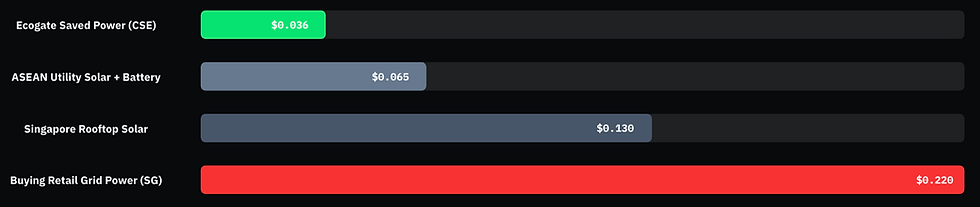
Cost of energy comparison per kWh in Singapore.
Singapore also offers funding pathways for energy-efficiency upgrades. The Energy Efficiency Grant has been broadened to support the manufacturing sector, and the National Environment Agency’s Energy Efficiency Fund provides co-funding for qualifying energy-efficient equipment and smart energy management systems.
Metric | Without subsidies | With 2026 regional grants |
Upfront system capex | $100,000 USD | $40,000 USD |
Annual utility savings | $44,000 USD | $44,000 USD |
Annual carbon tax savings | $2,640 USD | $2,640 USD |
CFO payback period | 2.1 years | 10.3 months |
Project 5-year IRR | 44% | 112% |
A two-year payback can already be attractive for a factory CFO. When incentives reduce the initial capital outlay, the same energy savings can push the project into a much faster payback window.
South Korea: Negawatts against imported energy and peak demand pressure
South Korea imports more than 90% of its energy, making efficiency a national security and industrial competitiveness issue. Industrial electricity prices have risen sharply since 2022 as KEPCO, the state-run utility, has worked through fuel-cost pressure and debt constraints.
The policy environment also favors demand-side action. MOTIE has set industrial energy-reduction priorities, KEPCO supports automated demand-side management hardware, and ESCO models are part of the broader push to reduce industrial load.

Cost of energy comparison per kWh in South Korea: Ecogate negawatts are 61% cheaper than solar and 72% cheaper than retail grid power in this comparison.
Deployed energy alternative in Korea | Levelized cost per kWh (KRW) | Levelized cost per kWh (USD) | Ecogate comparison |
Ecogate negawatt (saved power) | ₩50.2 KRW | $0.037 USD | The baseline benchmark. |
New domestic solar infrastructure | ₩130.0 KRW | $0.095 USD | Ecogate is 61% cheaper. |
KEPCO wholesale SMP break-even | ₩146.0 KRW | $0.107 USD | Ecogate is 65% cheaper. |
Buying Korean grid power (retail) | ₩181.9 KRW | $0.133 USD | Ecogate is 72% cheaper. |
New LNG thermal generation (fuel cost) | ₩205.5 KRW | $0.150 USD | Ecogate is 75% cheaper. |
IEEFA has reported elevated LNG generation fuel costs, while Korean solar targets still depend on long-term cost reductions. Against that backdrop, reducing industrial fan load can be one of the fastest deployed energy resources available to a factory.
The Netherlands: virtual grid capacity where power connections are constrained
The Dutch industrial energy environment is defined by grid congestion, or netcongestie. National and regional operators including TenneT, Liander, Enexis, and Stedin have reported severe grid-capacity constraints across much of the country.
For manufacturers, this can turn energy efficiency into production capacity. If a facility reduces a 200 kW extraction fan load by 60%, it can effectively release 120 kW on its existing electrical service during operation. That freed capacity may support new machinery, electrified processes, or expansion plans without waiting for a larger grid connection.
In this environment, Ecogate is not only an energy-saving system. It can operate as virtual grid capacity inside the plant.
The complete Ecogate system for on-demand industrial ventilation
Ecogate’s value comes from the full system architecture. The greenBOX controller acts as the system brain. Smart Gates and Precision Airflow Gates regulate and measure airflow at workstations. The Power Master VFD controls fan speed. Activity sensors identify real demand. The Dust Collector Controller and Interface extends visibility and control to collector-side equipment.

Complete Ecogate on-demand system for industrial dust, mist, and fume collection systems.
Each component has a specific role. Workstation sensors detect production activity. Gates open only where extraction is needed. The greenBOX calculates airflow requirements and maintains minimum transport velocities. The VFD reduces fan speed when demand falls. Analytics and system reporting help document performance.
Partnerships for OEMs, installers, and ESCOs
Industrial ventilation providers and Energy Service Companies can use Ecogate to turn efficiency into a stronger customer offer. For new dust, fume, and mist collection projects, Ecogate can be integrated from the beginning so customers do not lock in full-volume operation as their permanent operating model.
For existing systems, Ecogate can be evaluated as an upgrade path where fan energy, utility rates, incentives, or electrical-capacity constraints make demand-based control financially compelling. Partners can support customers with the Electricity Savings Calculator, ROI Estimator, system simulation resources, remote access, software updates, and performance data.
The takeaway
Factories need reliable industrial ventilation. They also need lower operating costs, more energy visibility, and more electrical capacity for the equipment that actually produces value. Ecogate addresses all three by creating measurable saved power from one of the most energy-intensive systems in many facilities.
The most cost-effective megawatt is often the one a factory no longer needs to buy, generate, or wait for from the grid. In industrial dust, fume, and mist collection, that makes an Ecogate negawatt one of the fastest power resources available.


Comments